Posts

Jesus Wants to Save Christians

Image
Here are some great quotes from this book by Rob Bell and Don Golden. "Writer Anne Lamott says that the most powerful sermon in the world is two words: 'Me too.' Me too. When you're struggling, when you're hurting, wounded, limping, doubting, questioning, barely hanging on, moments away from another relapse, and somebody can identify with you -- someone knows the temptations that at your door, somebody has felt the pain that you are feeling, when someone can look you in the eyes and say, 'Me too,' and they actually mean it -- it can save you" (pg 151). "The way of Jesus is the path of descent. It's about our death. It's our willingness to join the world in its suffering, it's our participation in the new humanity, it's our weakness calling out to others in their weakness" (pg 158) "... church is not ultimately about attending large gatherings. Church is people. People who live a certain way in the world. People who...
Memories of my Grandmother

These are random, I know, and there likely won't be a point, but... here goes: When I was a kid, maybe 3 or 4 years old, my brother -- who was a year older than me -- and I decided we'd hide on my grandmother who looked after us while both my parents worked. So picture this: 1964 Franklin Avenue, Niagara Falls, Canada. 2-story war-time house with pink siding. The second story has half walls; the top halves follow the angles of the roof lines. Concetta Cavallara Maiolo , a 50-yr-o ld woman, and her husband, Rocco, just three years in Canada living with their daughter and son-in-law loses her 4- and 3-yr-old grandsons. She's looking after the grand-kids while everyone else is working multiple jobs to help make ends meet. Anyhow, so my brother and I decide to do a disappearing act. From our hiding place we can hear our nonna becoming frantic, but do we show ourselves? No, we stay concealed between a wall and an ajar door. Finally she goes outside to get help. We decide to pl...

My Faith History: The Good the Bad and the Ugly

When I took the leap in 1977 and "asked Jesus into my heart" strange things happened. Some of them good and right, some of them weird and ugly. I remember that day, the day after and the two ensuing years vividly. That day was euphoric. Not everyone feels something when they make a commitment to change their lives. I did. It felt good -- like gears that I didn't know were there had clicked into place and my soul was in motion. The day after is when my faith journey started. On that day, I walked home from school with Dale. After, fifteen minutes, I was frustrated that I couldn't get him to see the light, so I told him that he was going to hell if he didn't accept the truth. He was not impressed. The following two years were filled with beauty and doubt; maturity and immaturity; and falling and growing. I met people who later fell hard from the faith and others who went on to be pastors and missionaries. I went to Catholic church, Lutheran church, house church and...

Can Books Change People?

Can books change people? Well, it's a silly question, really. It's inanimate; it has no innate abilities. I think more accurate would be the question, Can people change through reading great (or really good) books? I think that a great (or really good) book is an invitation to change. According to Robert P. Waxler , co-founder of the CLTL (Change Lives through Literature program) and English Professor of the University of Massachusetts , “Deep [reading allows us to] break free from our single lives…from the linear and local perspective of ordinary existence.” My current great and really good books are One Hundred Years of Solitude by Gabriel Marquez and the Harry Potter series by J. K. Rowling respectively. ............................. I started this post months ago and didn't finish. So now, I'm asking myself, Have I changed through reading the above mentioned books. How do I measure such a thing? What I remember about 100 Years, is the destructive power of isolat...

Harry Potter

Image
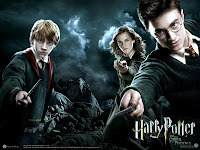
I know that this post is about 10 years behind the times -- which in web terms is about a century -- but I don't care. I'm going to blog about Harry Potter. Over 10 years ago, after Harry Potter and the Philosopher's Stone came out, I remember hearing all the scuttlebutt among religious folk about how the book and the author were evil (into witchcraft and stuff). I remember walking into a "conversation" between a young second year teacher and a student. The student was telling the teacher that Harry Potter was evil because it had witches and spells in it and, as a Christian, he thought that that was bad -- especially since it was a book for kids. The teacher was explaining that you can't be so black and white about things and that you shouldn't judge. Truth be told, I was keeping my head low, hoping to make like Harry with his invisible cloak and not be seen. No such luck. I was stopped and asked, "Hey Rocco, you're religious. What do you think o...

Disposable Information

The ease of getting information has made us lazy, I think. Maybe we don't retain it as well; it has become disposable. I mean, years ago if we wanted to find out how to fix a leaky faucet or if we wanted to know who Narcissus was, we'd have to go to the library, look through the card catalogue, maybe ask the librarian where to look, find the book, and read up on it. You'd think that if we wanted to know something that badly -- and went through all that trouble to learn it -- that we'd probably retain it. Or we wouldn't bother finding out at all because it wasn't worth the effort. Let me give an example: I ran across a word in a Steve Martini novel that I was reading. Cool word, I thought. I looked it up. I do that often at http://www.dictionary.com/ . The word meant a person having a homegrown, nontraditional kind of education. I didn't write the word down anywhere; now I can't remember the word and it's driving me crazy. Maybe if I had to go grab ...

Thoughts on Malcolm Gladwell's Outliers

Image
I was caught in the middle of a friendly debate regarding Outliers a while ago; it went something like this: EM: Outliers is a great book! ST: Ya, but what practical good is it? EM: Well it explains how... ST: Okay, what's its thesis in a nutshell? EM: (gives articulate answer) but it's not that kind of book. ST: I don't get it... EM: read the book... Anyhow, I'd been wanting to read the book, so I borrowed it from EM. I told him I'd tell him what I thought, so here it goes: What jumps out at me -- in direct response to the question "what good is it?" -- is the notion that there are no rags-to-riches, self-made success stories. Behind every huge success (like Bill Gates) there is opportunity, hard-work, community and legacy (cultural background). Most of those things don't answer the question above because they're out of the individual's control. The one thing that is not is "Community". As a teacher/parent/fellow human being, tha...